Picture a classic engagement ring. Chances are, you probably pictured a clear diamond without even thinking about it.
Now swap that diamond for a gemstone that could be forest green, soft pink, deep blue, peach, or even two colors in the same stone. Suddenly, the ring feels completely different.
That’s part of the appeal of tourmaline. For couples who want something outside traditional diamond engagement rings, a tourmaline engagement ring can bring color, natural variation, and plenty of room for customization while still fitting into familiar engagement ring styles.
It’s not really about finding a replacement for a diamond. It’s about choosing a center gemstone that feels more personal to you.
What Is a Tourmaline Engagement Ring?
A tourmaline engagement ring features tourmaline as the main gemstone, either as the center stone or as part of a multi-stone design.
Tourmaline is actually a group of related minerals known for having a huge range of colors. Depending on the individual stone, it can be pink, green, blue, peach, red, yellow, bi-color, or even show several colors at once. Watermelon tourmaline is a well-known example, with contrasting green and pink tones.
That range of color is one of the biggest reasons tourmaline works so well for alternative engagement rings.
Instead of only deciding on the shape of the stone, you can also choose a color or color combination that feels more personal. If you’ve always loved pink, green, teal, or something a little harder to define, tourmaline gives you plenty of options to work with.
Why Choose Tourmaline Instead of a Diamond?
Diamonds and tourmaline can create very different kinds of engagement rings.
Diamonds are known for their brilliance and hardness, and they’ve been a traditional choice for engagement rings for generations. Tourmaline has a different appeal. It’s often chosen for its color, natural variation, and individuality.
You might choose a tourmaline because it matches a favorite color, has interesting color zoning, or simply feels less conventional than a traditional colorless diamond.
That makes tourmaline a particularly interesting option for alternative engagement rings, colored gemstone rings, non-traditional bridal jewelry, personalized designs, and nature-inspired engagement rings.
Choosing tourmaline doesn’t mean you have to reject traditional engagement ring styles. You can still have a familiar solitaire, three-stone, or halo setting while simply choosing a center gemstone that feels more like you.
Tourmaline Offers an Exceptional Range of Colors
One of the most interesting things about tourmaline is that saying “I want tourmaline” doesn’t narrow the search very much.
You still have to pick a color.
Pink Tourmaline
Pink tourmaline ranges from pale blush shades to stronger pink and reddish tones.
It can work well with diamond accents and pairs with yellow, white, or rose gold depending on the individual stone.
Pink tourmaline is a natural option for someone who wants a colorful engagement ring without choosing a particularly dark center stone.
Green Tourmaline
Green tourmaline can range from lighter greens to deeper forest tones.
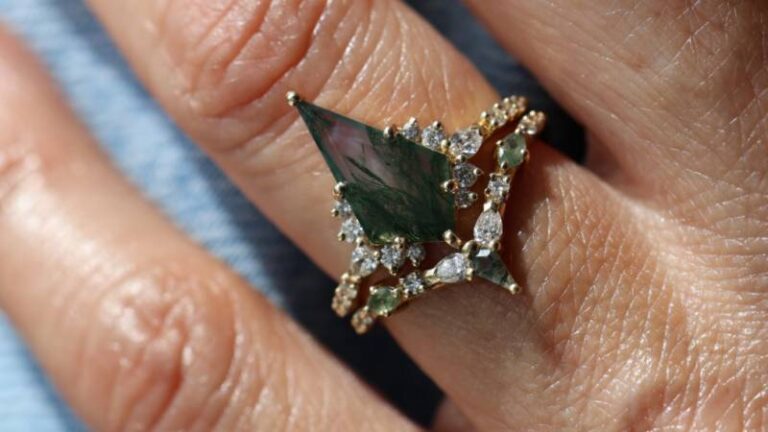
Its color makes it especially suitable for botanical and nature-inspired engagement ring designs.
For someone attracted to green gemstones but looking beyond emerald, green tourmaline provides another visual direction.
Blue Tourmaline
Blue tourmaline, including material associated with the variety indicolite, can display blue and blue-green shades.
A blue tourmaline center stone can create a strong contrast with yellow gold or a cooler overall design when paired with white gold or platinum.
Peach and Warm-Toned Tourmaline
Tourmaline also occurs in softer warm shades.
These stones can work particularly well for buyers who want color without choosing highly saturated pink, green, or blue.
What Is a Watermelon Tourmaline Engagement Ring?
This is where tourmaline gets particularly interesting.
Watermelon tourmaline can display pink or reddish color together with green, sometimes separated by a lighter zone.
Yes, it genuinely can look a little like watermelon.
No, that doesn’t mean your engagement ring needs to match the fruit salad at the wedding.
The natural color combination can create a center stone that looks noticeably different from conventional bridal gemstones.
Because color distribution varies between stones, watermelon tourmaline can work especially well in custom engagement rings where the setting is designed around the individual gemstone.
Bi-Color Tourmaline Makes Every Design More Individual
Some tourmaline gemstones naturally show two distinct colors within the same stone. This is known as bi-color tourmaline, and it’s one of the things that makes these gemstones so interesting for jewelry design.
Instead of designing around one uniform color, the jeweler can consider where the colors meet and how the stone should be positioned in the ring. The choice of metal, side stones, and even the overall shape of the setting can be used to complement or highlight that color transition.
An asymmetrical setting, for example, could make the change between the two colors part of the main design rather than something that simply happens to be there.
And because natural color zoning varies from stone to stone, two bi-color tourmalines that are roughly the same size and shape can still look completely different.
For anyone looking for a more individual engagement ring, that’s a pretty big part of the appeal.
Tourmaline vs Diamond for Engagement Rings
The two gemstones shouldn’t be compared only by appearance.
They also have different physical characteristics.
Diamond ranks 10 on the Mohs hardness scale, making it exceptionally resistant to scratching.
Tourmaline generally ranks around 7 to 7.5.
That means tourmaline can be used successfully in rings, but it requires more thoughtful wear than diamond.
| Characteristic | Tourmaline | Diamond |
| Color range | Very broad | Usually chosen colorless or near-colorless, though colored diamonds exist |
| Mohs hardness | About 7–7.5 | 10 |
| Bi-color stones | Commonly associated with tourmaline | Not a typical characteristic |
| Natural color zoning | Can be a major design feature | Usually not the primary design feature |
| Everyday care | More care required | Highly resistant to scratching |
| Design character | Colorful and unconventional | Classic to contemporary |
Neither gemstone is automatically “better.”
They solve different design priorities.
Is Tourmaline Durable Enough for an Engagement Ring?
Yes, but this answer needs context.
Tourmaline’s hardness of approximately 7 to 7.5 means it can be used in rings, including engagement rings.
However, hardness measures resistance to scratching. It doesn’t mean a gemstone is impossible to chip or damage.
Because an engagement ring may be worn every day for years, setting and lifestyle matter.
A tourmaline wearer should generally avoid exposing the ring unnecessarily to:
- Heavy impacts
- Gym equipment
- Gardening
- Manual work
- Harsh household chemicals
- Abrasive surfaces
For independent gemstone information, the Gemological Institute of America (GIA) tourmaline guide provides information about tourmaline’s properties, colors, and quality factors.
Which Settings Work for Tourmaline Engagement Rings?
Setting choice can balance design with protection.
Solitaire
A solitaire puts maximum visual attention on the tourmaline.
This is particularly effective when the gemstone has an unusual color or visible color zoning.
Bezel Setting
A bezel surrounds all or part of the gemstone with metal.
It can provide additional edge protection while creating a clean, modern appearance.
Halo Setting
A diamond halo can create contrast around a colored tourmaline.
Small colorless diamonds allow the center stone’s color to remain dominant while adding brilliance around it.
Three-Stone Setting
A tourmaline center stone can be combined with diamonds or other gemstones.
This creates opportunities to build a color palette rather than relying on one gemstone alone.
Nature-Inspired Setting
Leaves, branches, flowers, and organic metalwork can pair naturally with green, pink, and watermelon tourmalines.
Which Tourmaline Shapes Work for Engagement Rings?
Tourmaline can be cut into many familiar and unconventional shapes.
Options include:
- Oval
- Pear
- Cushion
- Emerald cut
- Round
- Marquise
- Radiant
- Geometric cuts
Elongated crystals can also make tourmaline particularly interesting for rectangular and elongated cuts.
With bi-color stones, the cut may be selected partly to preserve or emphasize the natural color distribution.
This is one reason choosing the actual gemstone can be especially important with tourmaline.
Which Metal Looks Best With Tourmaline?
There’s no universal answer because tourmaline comes in so many colors.
Yellow Gold
Yellow gold can create strong contrast with green and blue tourmalines while complementing warmer pink and peach shades.
Rose Gold
Rose gold can work particularly well with pink and warm-toned stones.
White Gold
White gold creates a neutral frame around the gemstone, allowing its color to become the primary focus.
Platinum
Platinum provides another naturally white-metal option for designs where a neutral setting is preferred.
Whenever possible, compare the specific gemstone against different metals rather than making the choice based solely on the label “pink” or “green.”
Why Tourmaline Works Well for Personalized Bridal Jewelry
Traditional bridal jewelry often emphasizes consistency.
Tourmaline can do the opposite.
A particular stone may have an unusual color transition, distinctive saturation, or combination of tones that influences the entire design.
When choosing a tourmaline engagement ring, buyers can consider the individual gemstone first and then select a setting, metal, and accent stones that work around its specific characteristics.
That approach makes tourmaline especially relevant for custom and personalized engagement jewelry.
Can Tourmaline Be Combined With Diamonds?
Absolutely. Choosing a tourmaline center stone doesn’t mean you have to give up the sparkle of diamonds.
Small diamonds can be added as side stones, around the center stone in a halo, along the band in a pavé setting, or even tucked into the design as a hidden detail.
The combination can work really well because the tourmaline brings the color while the diamonds add contrast and sparkle. You can also keep the rest of the setting fairly simple so the tourmaline remains the main focus.
For someone who loves the look of traditional diamond engagement rings but wants a more unusual center stone, a tourmaline and diamond engagement ring can be a nice middle ground.
What Does a Tourmaline Engagement Ring Symbolize?
Gemstone symbolism varies across traditions and shouldn’t be presented as a scientific property.
In modern gemstone symbolism, tourmaline is commonly associated with concepts such as:
- Love
- Creativity
- Individuality
- Balance
- Emotional connection
Different colors may also carry their own associations.
Pink tourmaline is often linked with affection and emotional connection, while green varieties are commonly associated with nature, renewal, and growth.
Tourmaline is also an October birthstone, which can add personal significance for someone born during that month.
But symbolism doesn’t have to come from a gemstone guide.
If a particular green matches the landscape where you first met, that may carry considerably more meaning than any traditional interpretation.
Who Should Consider a Tourmaline Engagement Ring?
A tourmaline engagement ring can be a great choice for someone who already knows they want color and isn’t necessarily looking for a traditional diamond center stone.
It can work especially well if you love colored gemstones, prefer less conventional jewelry, or are drawn to stones that have natural variations and don’t look exactly like every other gemstone. Tourmaline also gives you plenty of options if you’re looking for a pink, green, blue, or multi-color engagement ring.
It’s also worth considering if you’re interested in custom jewelry, since the natural color variations found in some tourmalines can give a designer more to work with.
The important thing is to consider both style and everyday wear. Tourmaline requires more care than harder gemstones like diamond or sapphire, so it’s worth thinking about how the ring will be worn and what kind of maintenance you’re comfortable with before choosing your stone.
Tourmaline Engagement Ring Buying Checklist
Before choosing a stone, ask:
Color: Do I love this specific tourmaline rather than simply the color category?
Cut: Does the shape emphasize the gemstone’s best characteristics?
Color zoning: If present, does the setting make good use of it?
Durability: Does the ring suit how I plan to wear it?
Setting: Is the gemstone adequately protected?
Metal: Does it complement the individual stone?
Craftsmanship: Is the gemstone securely set?
Customization: Could the design be adapted around this particular tourmaline?
With tourmaline, evaluating the actual gemstone is especially important because natural variation is part of its appeal.
Frequently Asked Questions
Is tourmaline good for an engagement ring?
Tourmaline can be used for engagement rings and offers a wide range of colors. With a Mohs hardness of approximately 7 to 7.5, however, it requires more thoughtful everyday wear than harder gemstones such as diamond or sapphire.
What colors are available for tourmaline engagement rings?
Tourmaline can occur in pink, green, blue, peach, red, yellow, bi-color, and multi-color varieties. Watermelon tourmaline is particularly recognizable for combinations of pink or reddish and green colors.
Is tourmaline cheaper than diamond?
Tourmaline and diamond pricing depends on factors such as size, color, quality, rarity, and individual stone characteristics. Some tourmalines can provide a different price point from diamonds, but affordability shouldn’t be the only reason to choose the gemstone.
What metal is best for a tourmaline engagement ring?
Yellow gold, rose gold, white gold, and platinum can all work with tourmaline. The best choice depends on the individual gemstone’s color and the wearer’s preferences.
Are tourmaline engagement rings considered alternative engagement rings?
Yes. Because they replace the conventional colorless diamond center stone with a colored gemstone, tourmaline rings fit naturally within the broader category of alternative and non-traditional engagement jewelry.
Final Thoughts
A tourmaline engagement ring doesn’t need to compete with a diamond by trying to imitate one.
Its strength is precisely that it doesn’t.
Tourmaline offers pink, green, blue, peach, bi-color, and multi-color possibilities, along with natural variations that can influence the entire design.
It also invites a different way of choosing an engagement ring.
Instead of starting with a standard setting and asking which stone fits inside it, you can find an individual tourmaline you love and build the design around its color, shape, and character.
For couples who see an engagement ring as an opportunity for personal expression rather than a requirement to follow tradition, that’s what makes tourmaline worth considering. See more.