
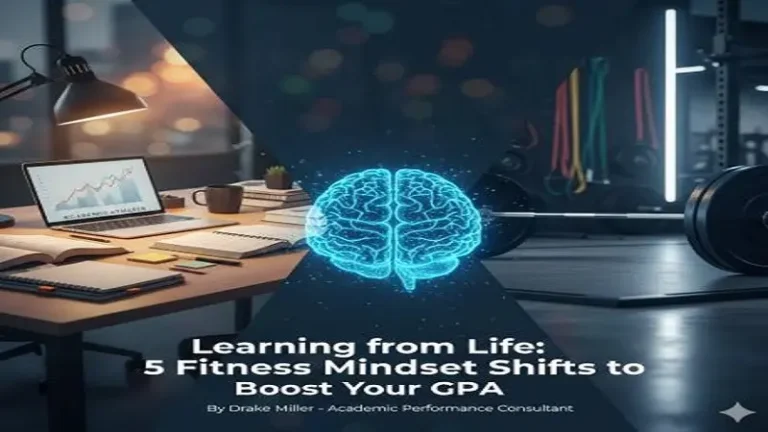
The modern American student is under a level of pressure that would break most professionals. From navigating the rigorous demands of Advanced Placement (AP) courses and Dual Enrollment to the high-stakes environment of SAT/ACT prep and Ivy League applications, the mental toll is staggering.
In my decade of coaching students across the USA, I often see high-achievers hitting a “performance plateau”—a point where studying more hours no longer yields higher grades. Interestingly, the solution to this academic burnout isn’t usually found in the library; it’s found in the gym.
Fitness culture is a masterclass in behavioral psychology and neurobiology. The same principles that transform an athlete’s physique can be applied to transform a student’s GPA.
The “Academic Athlete” Framework
Before diving in, let’s look at how the gym and the classroom mirror each other:
| Fitness Principle | Academic Application | Long-Term Result |
| Progressive Overload | Increasing Cognitive Difficulty | Neuroplasticity & Skill Mastery |
| Consistency/Sets | Daily “No-Zero” Study Habits | Reduced Finals-Week Stress |
| Recovery/Rest | Quality Sleep & Mental Breaks | Memory Consolidation |
| Data Tracking | Objective Error Analysis | Strategic Testing Efficiency |
| Deep Work | High-Intensity Concentration | Faster Learning (Less “Junk Volume”) |
1. The Principle of Progressive Overload in Cognitive Development
In strength training, Progressive Overload is the law of growth. If you lift the same 10lb dumbbell for three years, your muscles stall because they have adapted.
The Academic Parallel: Too many students fall into the trap of “passive learning”—reading the same highlighted notes without challenge. To achieve academic excellence, you must apply progressive overload to your brain. This means deliberately seeking “heavier” intellectual loads.
If you have mastered basic algebra, push into calculus. If you are struggling with complex business case studies, seeking marketing plan assignment help can provide the “spotter” you need to tackle more advanced strategic concepts. By systematically increasing the difficulty, you trigger neuroplasticity—the brain’s physical ability to form new neural connections.
2. Consistency Over Intensity: The “No-Zero Days” Rule
Fitness experts will tell you that a 30-minute workout five days a week is infinitely more effective than a six-hour marathon session once a month.
The Academic Parallel: Cramming is the academic equivalent of a “New Year’s Resolution” gym binge. Staying up until 4:00 AM might help you pass a midterm, but that information is gone within 48 hours. Real success is built on the “Non-Negotiable Routine.” Small, daily actions—like 20 minutes of SAT vocab or reviewing lecture notes immediately after class—compound over time.
3. Understanding the Recovery Phase: Solving Student Burnout
Muscles don’t grow while you are lifting; they repair and strengthen while you are sleeping. Overtraining without recovery leads to injury and stagnation.
The Academic Parallel: Student burnout is an epidemic. Your brain, much like a bicep, requires downtime to consolidate memories. Fitness culture teaches us that rest is a productive activity.
If the “academic weight” of your semester feels too heavy to lift alone, it is vital to seek structural support. Just as a pro athlete uses a physical therapist to manage recovery, a smart student might utilize my assignment services to help manage an overwhelming workload, allowing them to focus on health and sleep without sacrificing their GPA.
4. Tracking Data and Embracing “Functional Failure”
Elite athletes track “macros,” heart rate, and sleep cycles. When they fail a lift, they don’t take it personally; they look at the data: Was the form off? Was nutrition lacking?
The Academic Parallel: Students often view a bad grade as a reflection of their intelligence. Instead, view it as a data point. Use “stats”—how long you studied, your environment, and specific error types—to make tactical adjustments. High-level students use failure as a tool to refine their strategy for the next “set.”
5. The “Mind-Muscle Connection”: Practicing Deep Work
In weightlifting, the “Mind-Muscle Connection” is the ability to focus internally on the specific muscle being worked. Without it, you’re just “moving weight” without growth.
The Academic Parallel: If you are checking TikTok every ten minutes while “studying,” you are engaging in Junk Volume. In fitness, this refers to reps that don’t contribute to growth because intensity is too low. By removing distractions and practicing “intentional study,” you can accomplish in two hours what most students take six hours to do.
Frequently Asked Questions
Q.1 Can physical fitness actually improve my GPA?
Yes. Exercise increases BDNF (Brain-Derived Neurotrophic Factor), which acts like “Miracle-Gro” for brain cells, improving memory speed.
Q.2 How can I avoid “cramming” for exams?
Use Spaced Repetition. This is the fitness equivalent of a “split routine.” Instead of training one muscle for five hours, you train it in short bursts over several days.
Q.3 Is the “Mind-Muscle Connection” real in studying?
Absolutely. It is formally known as metacognition. When you focus deeply on a problem without distraction, you are maximizing the neural pathway for that subject.
Conclusion: Becoming an Academic Athlete
The journey to academic success is a marathon, not a sprint. By adopting the mindset of an athlete—focusing on progressive growth, maintaining consistency, and prioritizing recovery—you position yourself at the top of your class.
About the Author: Drake Miller is an academic performance consultant specializing in the intersection of physical health and cognitive function. With over a decade of experience helping USA-based students optimize their study habits, Drake promotes a “holistic athlete” approach to education. He believes that the discipline of the weight room is the ultimate blueprint for the classroom.